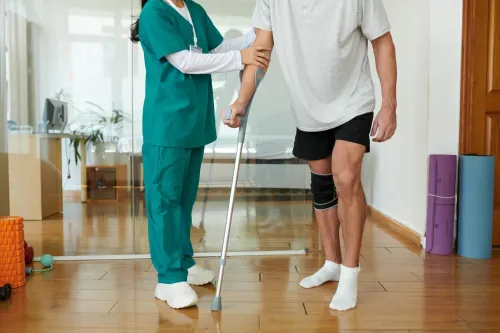
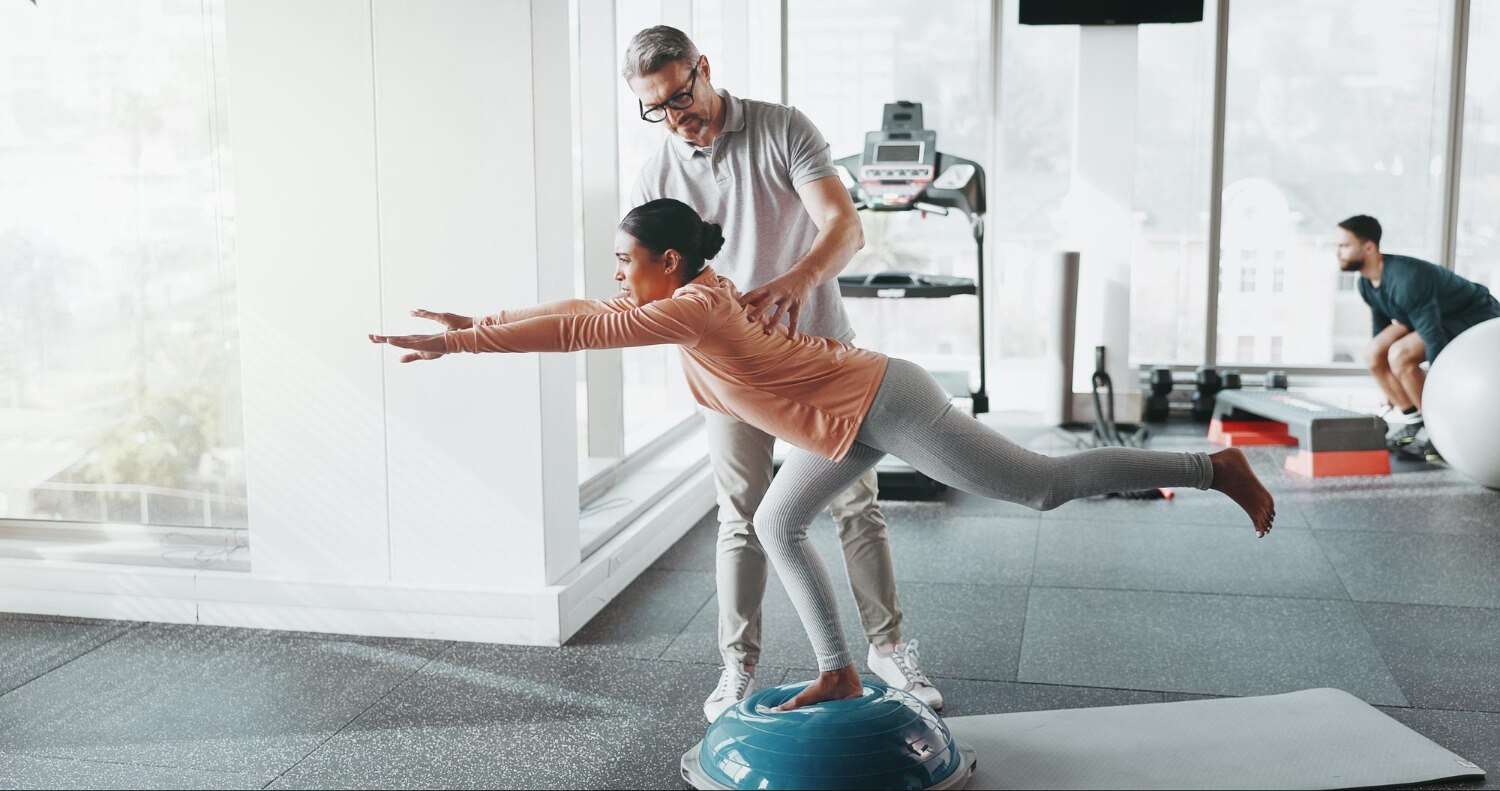
Pain, swelling, weakness and reduced weight-bearing can make you unstable even after walking becomes possible again. You will learn how to progress from supported exercises to real-world tasks, match training to your injury or surgery, practise safely at home, and judge improvement using functional measures rather than a single-leg score alone.
Key takeaways
- Start balance exercises with stable support and follow your weight-bearing limits.
- Progress from weight shifts to stepping, turning and uneven-surface practice.
- Stop if pain sharply increases, swelling worsens or your knee gives way.
- Track standing time, step control and confidence to measure rehabilitation progress.
Why balance changes after an orthopaedic injury or surgery
Pain relief does not immediately restore balance. After an orthopaedic injury or operation, your body may still protect the area by shifting weight away from it, shortening your steps or stiffening the joint.
That altered pattern makes turning, stepping over an obstacle, rising from a chair or walking on uneven ground less secure than quiet standing.
Balance can remain unreliable because:
- Pain and swelling reduce joint movement and make you guard the injured side.
- Reduced weight-bearing and inactivity weaken the hip, thigh, calf or trunk muscles that keep you upright.
- Joint stiffness changes how your foot, knee, hip or spine responds when your position shifts.
- Injury can reduce proprioception, the feedback that tells your brain where the joint is without looking.
- Fear of movement encourages cautious, uneven walking and further reduces confidence.
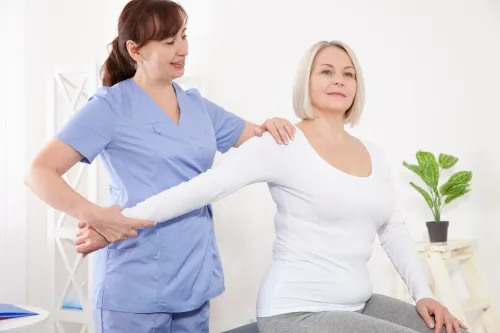
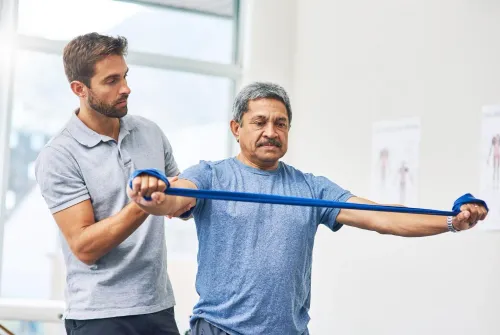
A search for fitness balance training for benefits after orthopaedic injury in vadodara should lead to an individualized programme, not a generic routine. Exercises that rebuild weight shifting, joint control, strength, gait and reactions can improve steadiness during daily tasks and help you trust the repaired or injured limb again.
The plan must match your operation, weight-bearing restriction and tissue healing; unsupported single-leg work is unsafe until your surgeon or physiotherapist clears it. Dizziness or vertigo points toward vestibular assessment rather than musculoskeletal balance work alone.
How balance training progresses from support to everyday movement
Progress from stable, supported positions to stepping and real-life tasks; do not skip levels because an unstable surface feels harder.
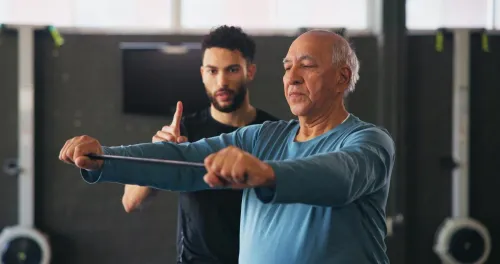
- Begin with supported weight shifts and double-leg standing while holding a walker, rail or countertop.
- Move to staggered stance, reduced hand contact and controlled reaching within your permitted range.
- Add supported single-leg loading only when your clinician clears it, then practise brief single-leg balance.
- Introduce forward, sideways and backward stepping, turning, and changes in walking speed.
- Finish with task-specific drills such as stairs, carrying an object, stepping around obstacles or walking on the surfaces you use daily.
The right sequence changes with the operation and its loading rules. Follow these distinctions:
- Fracture: Keep to the prescribed non-weight-bearing, partial-weight-bearing or full-weight-bearing limit. After hip-fracture surgery, supervised mobilisation often begins the day after surgery unless contraindicated, but high-level single-leg work comes much later.
- Ligament injury or repair: Protect the repaired tissue and follow its brace, range-of-motion and loading limits. Do not test pivoting, sudden direction changes or unsupported single-leg balance before clearance.
- Joint replacement: Respect hip or knee movement precautions, wound status and walking aid instructions. Progress transfers, symmetrical standing and gait before uneven surfaces or carrying loads.
- Spinal procedure: Follow restrictions on bending, lifting and twisting, and prioritise aligned standing and walking. New weakness, numbness or loss of control requires prompt medical review.
Balance training after surgery is safe only when the surgeon or physiotherapist matches each step to healing, pain and control. Stop for worsening pain, swelling, wound problems, calf symptoms, faintness or breathlessness.
How to make balance exercises safe when loading is restricted
Do not begin balance training after surgery until your surgeon or physiotherapist confirms the allowed weight on the limb, joint-movement limits, repair precautions and wound status. A non-weight-bearing or partial-weight-bearing order rules out unsupported single-leg drills, even if pain is low.
1. Exercise only in a clear area beside a fixed kitchen counter, wall rail or correctly adjusted walker. Wear secure, non-slip footwear; remove loose rugs and keep a helper beside you when the drill exceeds your usual control.
2. Modify the drill if you lose alignment, need to grab suddenly, or feel mild effort without worsening symptoms. Use both hands on support, reduce the standing time, keep both feet down, or switch to weight shifts and supported stepping.
3. Stop immediately for increasing pain, swelling, wound leakage or separation, new numbness, new weakness, marked dizziness or faintness. Do not restart until your rehabilitation clinician reviews the change.
4. Seek prompt medical assessment for fever, calf swelling or calf pain after surgery. Chest pain or sudden breathlessness requires emergency help, not another exercise attempt.
Never practise with closed eyes, on a wobble surface or while carrying an object until you can control basic standing and stepping. The correct challenge is one you can repeat without breaking the surgical precautions or creating a fall.
How to practise, measure progress and choose the right rehabilitation approach
Train balance for 10–20 minutes, three to five days a week, if your clinician permits that loading level. Practise near a kitchen counter or rail, stop for increasing pain, swelling, dizziness or loss of control, and progress only when you can repeat the movement without compensating.
A clinician should measure more than how long you stand on one leg:
- Pain, swelling, joint range, weight-bearing tolerance and strength difference between limbs.
- Gait speed, turning, stair control, five-times sit-to-stand and a validated balance test.
- Movement quality, confidence, falls history and performance of your actual goal, such as uneven pavements, chair transfers or work tasks.
A better clinic score does not prove safe community walking. For balance physiotherapy after injury in Vadodara, ask how the programme will test your footwear, stairs, transport route or sport demands.
| Rehabilitation focus | Add it when | What progress should show |
|---|---|---|
| Balance plus strength | Weakness or poor joint control limits standing or stepping | Better limb symmetry and controlled loading |
| Gait training | You limp, use an aid or lose stability while turning | Smoother walking, speed and obstacle clearance |
| Flexibility | Stiffness restricts foot, knee, hip or trunk movement | More useful range without pain or compensation |
| Vestibular rehabilitation | Dizziness, vertigo or gaze instability drives unsteadiness | Improved head movement and visual fixation |
| Neurological rehabilitation | Numbness, coordination loss or abnormal tone is present | Better motor control, reactions and task independence |
After ACL reconstruction or major surgery, use swelling, range, strength symmetry, movement quality and task readiness—not the calendar alone—to decide when running or cutting is appropriate.
What fitness balance rehabilitation in Vadodara should look like in practice
A useful local assessment tests the tasks you need in Vadodara, not just how long you can stand on foam. Fitness balance rehabilitation in vadodara is worthwhile when the clinician links your score to getting out of a chair, climbing stairs, crossing uneven pavements, boarding an auto-rickshaw, working safely or returning to sport.
- Bring your actual constraints: weight-bearing instructions, walking aid, footwear, stair layout, bathroom setup, commute and job duties.
- Ask the clinician to observe turning, stopping, sit-to-stand, stepping over an obstacle and carrying an object, then repeat these tasks as control improves.
- Choose musculoskeletal assessment for weakness, joint stiffness, poor proprioception or altered gait. Choose vestibular assessment when vertigo, dizziness or gaze instability drives the unsteadiness.
- Reassess the task that matters to you, not only a balance score. A better score with continued fear on stairs is incomplete recovery.
| Setting | Useful assessment | Progression to practise |
|---|---|---|
| Home | Chair rise, bed transfer, bathroom turns and narrow spaces | Practise with the same rail, footwear and walking aid |
| Work | Standing tolerance, reaching, lifting and direction changes | Add job-specific loads, distances and time limits |
| Transport | Kerbs, uneven pavement, ramps, vehicle entry and sudden stops | Train stepping, turning and controlled walking outdoors |
| Sport | Landing, cutting, hopping and reaction to movement | Progress only when strength, swelling and movement quality support the demand |
At Physiospace By Dr. Pratiksha, ask whether the assessment includes your home, workplace or travel demands rather than a clinic-only score.
Related services
Neurological Rehabilitation Physiotherapy is a specialized rehabilitation service designed to improve walking ability, body balance, coordination, and mobility in individuals... View service → |
Orthopedic Rehabilitation Physiotherapy – Expert Recovery & Mobility Restoration Recover safely and regain your strength with Post-Fracture Rehabilitation Physiotherapy at... View service → |
Frequently asked questions
Why does balance change after an orthopaedic injury or surgery?
Pain, swelling, weakness and protective movement patterns can shift your weight, shorten your steps and reduce joint control.
How does balance training progress after an orthopaedic injury?
Rehabilitation usually moves from supported weight shifts and stable standing to stepping, turning and everyday movement tasks.
How can you practise balance safely when loading is restricted?
Use the prescribed weight-bearing limit, hold stable support, clear the floor and stop for sharp pain, worsening swelling or instability.
How do you measure progress during balance rehabilitation in Vadodara?
Track standing time, weight distribution, step control, turning ability, near-falls and confidence during tasks relevant to daily life.
Related services
Personalized Exercise Programs Physiotherapy Maintaining a healthy weight is essential for overall well-being, mobility, and long-term health. At Physiospace By Dr. View service → |
Geriatric Physiotherapy Physiotherapy in Vadodara Regain your freedom of movement with professional Mobility Improvement Physiotherapy at Physiospace By Dr. Pratiksha. View service → |
Sports & Fitness Rehabilitation Physiotherapy in Vadodara is a specialized rehabilitation and performance enhancement service designed to improve strength, mobility, endurance,... View service → |
Orthopedic Rehabilitation Ligament & Sports Injury Management Physiotherapy in Vadodara Recover faster and return to your active lifestyle with professional Ligament & Sports Injury Management Physiotherapy... View service → |
Keywords